


AI and Data Charter Banner
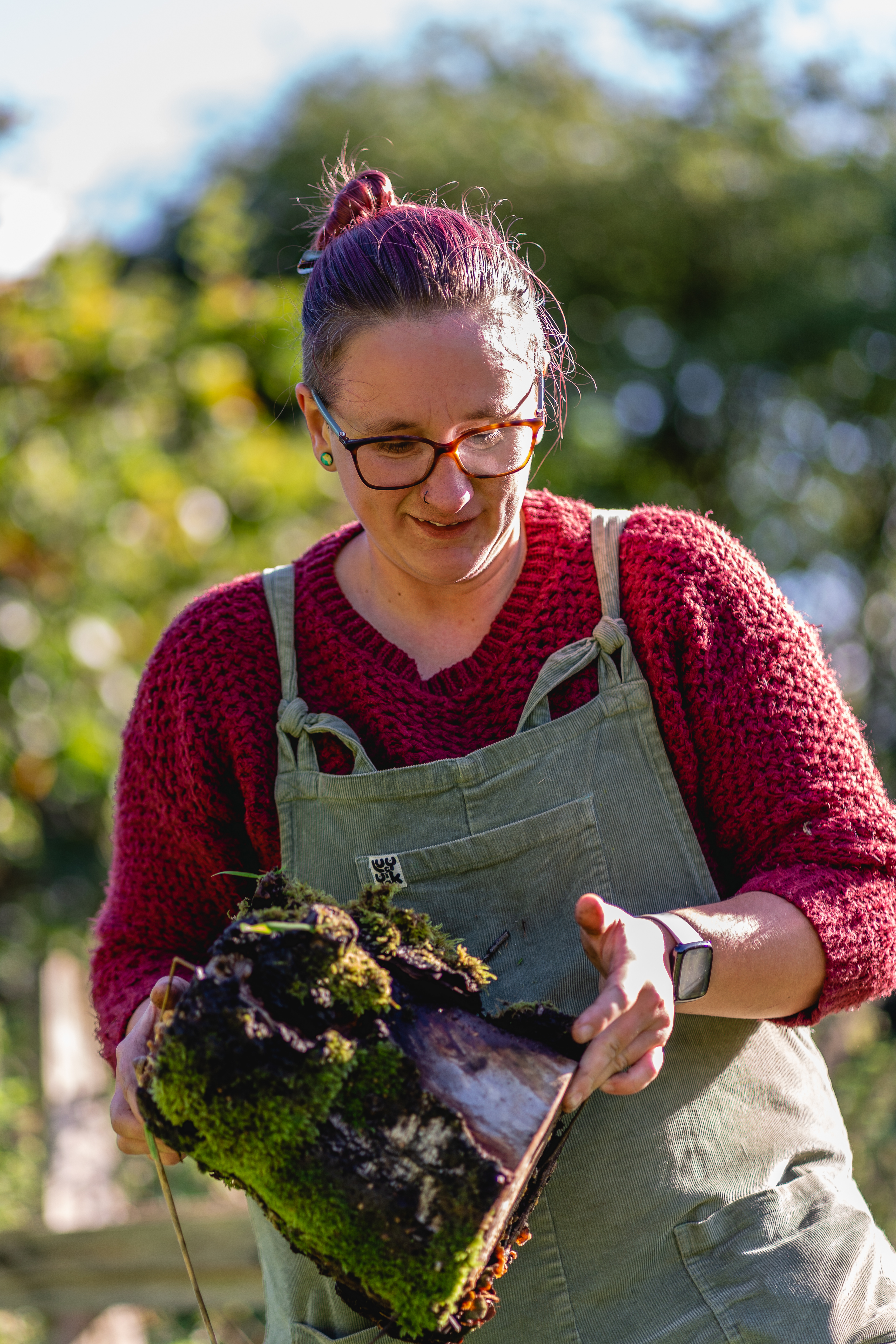
The Civic Data Coop worked with local residents representing a cross-section of Liverpool City Region to create a community-led AI & Data Charter.
Consisting of 11 principles, the charter offers clear guidance for local companies, organisations and statutory services to work towards when developing their use of AI and data within their everyday processes and procedures.
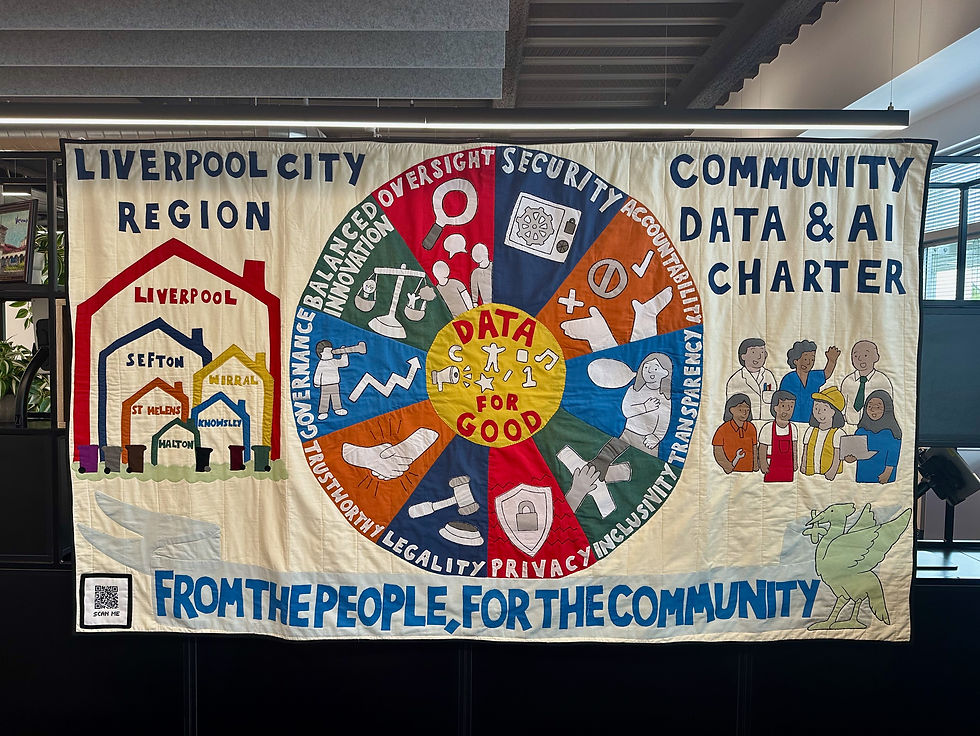
As part of the consultation and development of the charter, attendees were asked how the charter and its guiding principles could be visualised to help increase engagement. A banner inspired by protest and trade union banners, such as those displayed at the People’s History Museum in Manchester, was proposed. Toni-Louise Carter and I were commissioned to create this textile banner.
Construction
Toni-Louise Carter is an illustrator also based at Hazlehurst Studios alongside myself. She specialises in consultation work and in visualising conversations and lived experiences of community members.
Working together with Civic Data Coop data scientists Dr Emily Rempel and Chantelle Murphy, we developed the initial visualisations and conversations from the resident sessions into a structured banner design.

The design highlights key aspects of the charter as well as elements that reflect the make-up of the Liverpool City Region, including the highest employing job sectors and the population levels of each borough.
Wheelie bins and waste management were recurring topics within the sessions, and this became a strong visual device within the banner. Each borough in the Liverpool City Region has a different coloured wheelie bin, which provided a way to represent each borough equally and on a level playing field.

Once the final design was confirmed, I created the textile piece using traditional hand and machine embroidery, quilting and appliqué techniques.
Each design element was transferred from Toni’s illustrations into fabric using reused materials such as bedding, clothing and curtains. The only new fabric used was for the backing, to ensure durability and longevity. Some fabrics were hand-dyed to accurately match the design.
Construction Data
As the piece represents and celebrates data, I timed and calculated how long each element took to create, demonstrating that data exists within everything we do — even traditional textile techniques.
Time Breakdown:
Tracing pattern – 4 hours
Quilting backing fabric – 4 hours
Cutting out pattern – 4 hours
Lettering – 46 hours
Professions data visualisation – 8 hours
Liverbird – 4 hours
Borough houses – 8 hours
Wheelie bins and grass – 3 hours
Centre circle illustrations – 24 hours
Centre circle background – 3 hours
Slogan ribbon background – 2 hours
Binding around edge – 3 hours
Sewing on QR code – 1 hour
Signatures – 0.5 hours
Pressing/ironing finished banner – 1 hour
Total: 115.5 hours
Public Consultation
A key element in the Civic Data Coop commissioning this banner was to start conversations with the Liverpool City Region community and its residents.
Toni and I delivered live demonstrations during the banner’s construction to encourage dialogue. Two of these sessions included the launch of the charter itself, attended by representatives from health, education and statutory organisations. These demonstrations highlighted the role that visual arts and creativity can play in communicating ideas and projects within the scientific and health sectors.
The second event was the 10th annual Liverpool Makefest, where residents from across the city region were able to attend and explore makers for free. At both events, we asked participants: “What colour is your wheelie bin?” This simple question opened conversations about which borough they were from and what data could already be inferred from that answer. It encouraged discussion around how personal and community data is collected, why it matters, how it should be protected, and how it can be used for community benefit.

Through the making of this project, both Toni and I developed a deeper understanding of what data actually is, its importance, and the significance of community ownership. The project also highlighted the role the arts can play in brokering and facilitating conversations between scientists, health professionals, statutory service providers and the communities they support.
Related Websites:
Basic Charter Overview
AI and Data Charter Final Report
We hope this banner will become a lasting symbol of this important community-led charter, continuing to spark conversations and create educational opportunities around AI and data within the city region, and supporting the use of “Data for Good.”

This was a thought-provoking read that emphasized the significance of careful AI and data exchange. A well-made banner may keep viewers interested while simplifying difficult concepts. It serves as a wonderful reminder that expert banner design services are about more than just eye-catching graphics; they assist in conveying messages that are understandable, trustworthy, and consistent with a brand. I appreciate you providing these insightful viewpoints and inspiring ideas.